Cave Anna
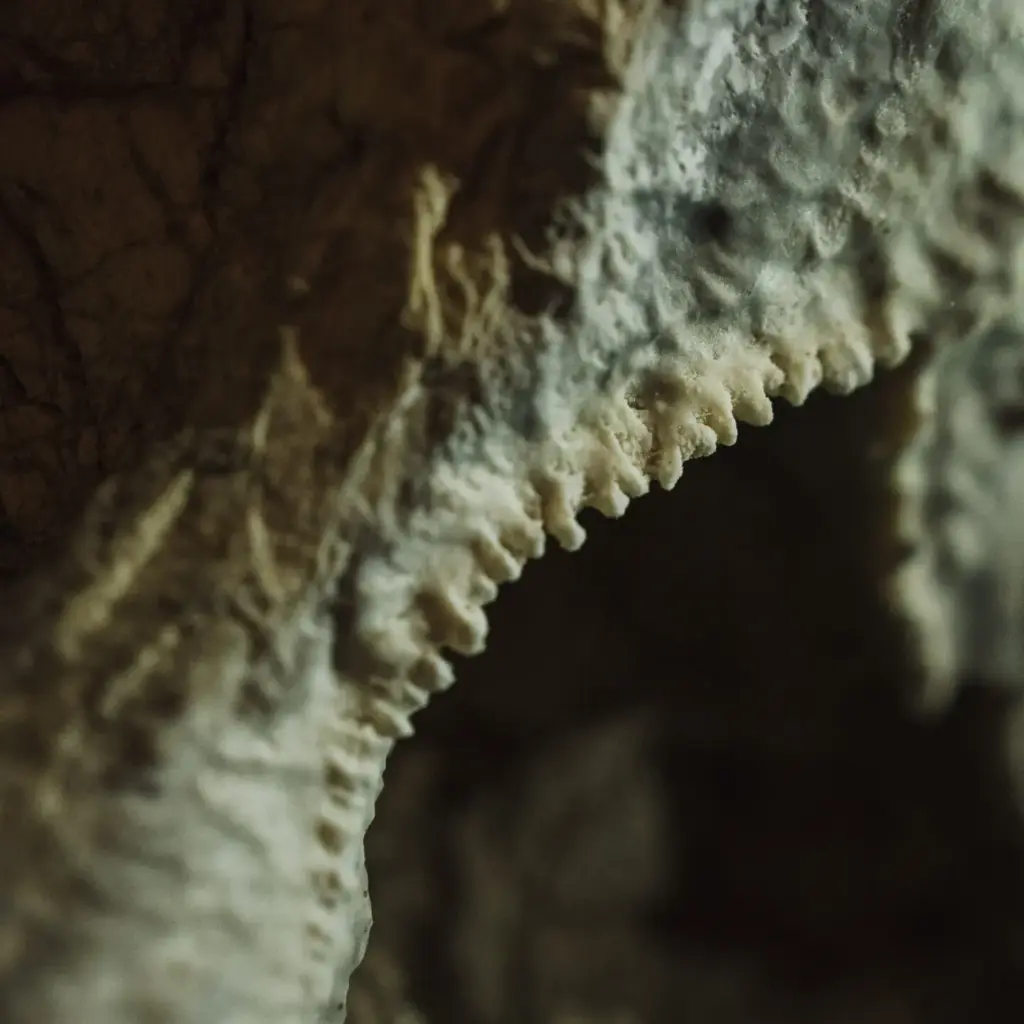
The Anna Tufa Cave is one of the country's most extraordinary caves. There are only six like it in the whole world, since tufa caves are generally not open to visitors.
In the tufa passages, wonderfully beautiful formations can be seen; beyond the hanging stalactites, lace-fine spring-limestone formations are visible. The petrified plant remains – root, tree, moss and bark – and their imprints are considered a curiosity.
The cave can be visited all year round with a guided cave tour. The total length of its passages is 570 metres, of which the section on display is 208 metres.
Kecske-lyuk Cave
Reachable via the Forrás Valley forest nature trail, the Kecske-lyuk Cave is a strictly protected cave of the Bükk Mountains. It takes its name from its large, 6-metre-high and 6-metre-wide triangular entrance. Its entrance hall was once a summer stable and midday resting place for animals. This may also be the origin of its name. It is a popular excursion spot thanks to its easy accessibility.
Its geologically and biologically significant cavity system stretches to a length of 480 metres, to a depth of roughly 23 metres, at 256 metres above sea level.
The cave can be walked in street clothes for up to 100 metres. It can be freely visited with due care. It is a favourite dwelling place of a strictly protected, sizeable bat colony. The first description of the cave, known since ancient times, was published in 1882 by Sándor Márki.
Szeleta Cave
Szeleta Cave is one of Hungary's strictly protected caves and one of the sites of the first cave excavations in Hungary. It is the namesake of the Szeleta Palaeolithic culture.
Because of its location, too, it is a passage system in a special position. At its top there is a viewpoint offering an unparalleled view over the Szinva Valley and Hámor.
At the cave's wide entrance is a memorial plaque to Ottó Herman, since it was partly through the intercession of the famous Hungarian polymath that Ottokár Kadić began his significant excavations at the site in 1906. During the excavations, finely crafted tools and implements from the Ice Age were found.
A black line on the cave wall marks where the cave's original level was before the excavations. Based on the tools found here, the prehistoric people who once lived here are classified as belonging to the Szeleta or Szeletian culture.
Szeleta Cave is most easily reached from the Szinva nature trail, following the red – and red cave – markings, or from the roadside at Felső-hámor, the red square and red cave markings.
Saint Stephen Cave
The Saint Stephen Cave in Lillafüred is a strictly protected stalactite cave whose entrance opens 500 metres from the Palace Hotel, beside the Eger main road.
The total length of its passages is more than 1 km. The cave's vertical extent is 94 m. Currently, the length of the section on display, counting there and back, is 340 metres. It can be visited all year round with a guided cave tour.
Its literally fabulous stalactite formations make visiting the cave an unforgettable experience. In the cave, the dripstone formations bear fanciful names given to them by visitors. Its largest dripstone formation is the "Frozen Waterfall" of the Dome Hall.
Harmless and protected bats live in the passages, which every visitor can encounter during the cave tour.
The cave was discovered by chance. According to legend, a dog fell into its natural shaft opening on the steep hillside and, with its days-long barking, drew attention to itself and the shaft, after which the exploration of the passage system began. Its discovery and first scientific description are officially attributed to Ottokár Kadić and can be dated to 1913.
The cave's so-called Black Hall is used for medical purposes. In the hall, treatments are held for adults and children suffering from upper respiratory complaints, for which the site's constant temperature of around 10 °C and 100% humidity are ideal.